


I DON'T see couples for relationship counselling, marriage counselling, or civil partnership therapy.
Please note, for relationship counselling, I ONLY see individuals privately (independently of their partner),
who want to work through their OWN, SPECIFIC concerns, issues in their relationship.
Relationship Counselling London & Marriage Counselling London
(See also Relationships With Others, The Wider World & Indeed Ourselves)In This Section:
Relationship Counselling
& Marriage Counselling
- Introduction To Marriage & Relationship Counselling London
- After The Relationship Or Marriage Has Ended - Counselling London
- What To Expect From Relationship Counselling London
- What NOT To Expect From Relationship Counselling
Fear Of Dependence, Commitment
Engulfment, Abandonment, Rejection
- Emotional Avoidance Or Dependency In Relationships
- States Of Dependence, Codependence, Independence, Interdependence
- Codependency (Co-Dependency) - Caretaking
- Enmeshment
- Commitment Concerns, Commitment Anxiety, Commitment Phobia
- Being Autonomous Yet Part Of A Couple
- Differences Between Us & Our Partner
- Healthy Boundaries & Resilience In Relationships
- Fear Of Engulfment
- Fear Of Separation, Loss, Rejection & Abandonment Issues
- Relationship Dances - Pushing & Pulling
- Sabotaging Things In The Relationship Or Marriage
- Living Together, Relationship Commitment, Pre-Marital Counselling, Pre-Nuptial Counselling
Love Needs, Love Addiction, Love Addicts - Relationship Counselling
- Nature Of Love In Its Many Forms
- Romance In The Relationship Or Marriage
- Flirting
- Dating Considerations
- Online Chat Addiction, Text Chat Room Addiction & Internet Dating Addiction Counselling London
- Perfect Love, Idealised Love
- Elusive Love? - Struggling To Make Lasting Relationships
- Beliefs About Love, Beliefs About Relationships
- Dilemmas Of Love, Fear Of Love, Scared Of Love, Afraid Of Love
- Confidence, Esteem, Insecurity, Anxiety & Fear In Relationship Or Marriage
- Unmet Love Needs & Emotional Neediness
- Love Addiction, Romance Addiction & Obsessive Love
- Loneliness & Aloneness In The Relationship Or Marriage
- Choosing To Love
- Giving, Receiving & Sharing Love - Loving & Being Loved
Trust, Intimacy, Love, Touch & Sex
In The Relationship Or Marriage
- Trust, Vulnerability & Intimacy In The Relationship
- Intimacy Avoidance In Relationships
- Qualities Of Touch
- Sexual Relationship, Sexual Marriage
- Sexuality
- The Effects Of Pornography
- Safety In Our Relationship, Marriage
- Love Avoidance, Love Avoidant
- Relationship Style, Attachment Patterns
Scapegoating, Controlling Behaviour, Blaming & Criticism - Counselling London
- Scapegoating - Being Scapegoated
- Control Issues, Controlling Behaviour In The Relationship
- Manipulative Behaviour
- Blame & Criticism In The Controlling Relationship
- On The Receiving End Of Someone's Unhelpful Behaviour
- Turning Our Partner Into The Enemy
- Projecting Onto Others
- When Our Partner Is Unloving
- Wanting To Change Others, Our Partner
- Our Behaviour In The Relationship Or Marriage
- Crushing Behaviour
- Competitiveness In The Relationship Or Marriage
- Pushing Each Other's Buttons
- Power Struggles In The Relationship & Marriage
- Withholding, Withdrawing, Disengaging
- Giving Or Receiving "The Silent Treatment"
- Putting Up Walls In The Relationship Or Marriage
- Locked Into Positions In Our Relationship
Relationship Expectations, Hooks, Triggers
Disappointments, Hurt, Attitudes & Roles
- Relationship Expectations, Assumptions & Disappointments
- Relationship Hurt, Fear Of Getting Hurt
- Attitudes In The Relationship Or Marriage
- Old Hooks, Buttons, Triggers, Played Out In Our Relationship
- Relationship Roles, Patterns & Characteristics
- Balance In The Relationship Or Marriage
Continuing Or Ending
The Relationship Or Marriage
- Rushing Headlong Towards Separation Or Divorce
- Nurturing Or Ending The Relationship
- Towards Making The Relationship Or Marriage Work
- Towards Break Up, Separation, Divorce & Beyond
- Letting Go Of Our Relationship Or Marriage
- Role of Counselling in Relationship Resilience
- Role of Counselling In Separating Or Divorcing
Affairs, Infidelity & Unfaithfulness
In The Relationship Or Marriage
- Infidelity, Affairs
- Emotional Affairs, Limerent Love
- Online Chat Rooms, Internet Chatting, Cyber Chats & Internet Dating
- Seeing Someone Else, Affairs, Infidelity, Cheating In Our Relationship
- Online Infidelity, Internet Affairs, Cheating On Someone
- Serial Sexual Relationships, Cheating In Our Relationship
- Cybersex, Internet Sex Addiction & Online Porn & Pornography Addiction
- Reflections, Way Forward
- Deceived Partners Reflections On Their Relationship, Marriage
- The Challenges Ahead For Both Of Us
Communication, Conflict & Empathy Counselling London
- Strengthening Relationship Communication - How We Relate
- What May Be Happening Between Us
- Conflict In The Relationship Or Marriage
- Dealing Effectively With Conflict
- Being Heard, Seen, Appreciated & Met In The Relationship Or Marriage
- Emotional Engagement, Emotional Connection, Emotional Intimacy
- Responding To Our Partner's Feelings, Needs, Views
- Empathy For Others, Our Partner
- Being Congruent, Choosing To Speak Our Truth
- Compromising
- Having A Healthy Fight In The Relationship Or Marriage
- Maturity As A Couple
- Unconscious Communication In Relationship Or Marriage
- Listening
- Relating With Others, Friendships - Building, Strengthening & Deepening Relationships
- What We, Others Observe - Giving, Receiving Feedback To & From Others, Our Partner
- Family Problems, Rifts, Estrangement, Inter-Cultural, Interracial Issues, Religious Differences, Sexuality
- Social Media Addiction Counselling London
- Mobile Addiction Counselling In London, Email, Text, Telephone Addiction, Nomophobia
Envy & Jealousy
In The Relationship Or Marriage
- Overcoming Jealousy, Envy & FOMO Counselling
- Effects of Previous & Future Relationships
- Envy & Jealousy In The Relationship Or Marriage
Overdemanding, Undermining, Emotional Abuse, Possessiveness
- Undermining In The Relationship Or Marriage
- Possessiveness In The Relationship Or Marriage
- Drama Triangle of Victim, Rescuer, Persecutor
- Being Overdemanding Of Our Partner
- In A High Maintenance Relationship
- Emotionally Abusive Relationships
Stuckness, Staleness, Neglect & Apathy In The Relationship Counselling London
- Stuckness, Staleness In The Relationship, Marriage
- Lonely in The Relationship, Marriage
- Sidelined
- Inaction - When Our Partner Doesn't Initiate
- Living Parallel Lives In A Transactional Relationship
- Procrastination In The Relationship Or Marriage
- Apathy, Indifference In The Relationship Or Marriage
- Abandoning Our Partner & Us In The Relationship
- Emotional Neglect & Letting Ourself Go
- Disinterest
- Giving Up On Passions
- Not Taking Responsibility In The Relationship, Marriage
- Depression In The Relationship Or Marriage
- Our Responses
Relationship Problems & Marriage Problems - Counselling London
- Other Problems In The Relationship Or Marriage
- Preoccupation In The Relationship Or Marriage
- When Our Partner Isn't Acknowledging A Problem
- Long Distance Relationships
- Money Matters In The Relationship Or Marriage
- Resolving Marriage Issues, Relationship Problems
- Family Problems, Rifts, Estrangement, Inter-Cultural, Interracial Issues, Religious Differences, Sexuality
Crisis, Challenges, Changes & Transformations In The Relationship
Introduction To Marriage & Relationship Counselling London
People come into your life for a reason, a season or a lifetime.Unknown
When you figure out which one it is, you will know what to do for each person.

Relationship Context - What A Relationship Means For Us Being OK with another begins with being OK with ourself, so the relationship with ourself underpins our relationship with others. And our first relationship - early connections & bonding patterns alongside any non-responsiveness, empathic breaks and frustrations in our early life can greatly influence our adult relationships. Relationships are essential to our resilience, wellbeing and happiness. Happy relationships don't happen by accident and only we can change what we do to make them happier. We can love someone yet being together can be challenging at times. We may have different contexts, needs, attitudes, expectations and models about a good relationship, marriage including whether it should last forever, be exclusive. Whatever our culture, sexuality, religion, matters of the human heart are universal, as is the complexity, pain, and joys of human relationships with others. Relationships are not something we have, we continuously build them, evolve in the journey of them as a couple. The relationship and marriage counselling can explore whether we feel relationship-ready (see also Being Relationship-Ready & Sharing (Not Necessarily Agreeing With) Each Other's Vision Of The Kind Of Deep & Meaningful Relationship, Marriage We Really Want), what the journey of a relationship, marriage means for us and what keeps us safe in it and also explores our primary relationship with our Self (for we can't be happy, fulfilled, in our relationship unless we are fulfilled and happy in ourself) alongside our relationship and communication style with our partner, others.
Our issues only get triggered within our relationship - not when we're alone. The closer the relationship, the deeper the wounds become activated, providing us with opportunities to heal whet we need to heal, learn, love.
How Our Relationship Teaches Us Who We Are All of us have a public life, which we show to the world, a private life, which we show to those close to us, a secret life of our innermost world, some of which we choose to share and some of which we keep to ourselves. Relationships enable us to know ourselves better, understand who we are. When our partner is there for us first in the morning, last thing at night, they get to know us well - maybe our private fears, shadow side, our joys. They witness us in playful or despairing moods. Our masks may be off, and we no longer need to play a role. We can be vulnerable, share, express things from the heart, including our passions, deepest, darkest selves that we usually wouldn't. Our partner can see things we no longer do, e.g. any of our delusions, maybe what's missing about ourselves, both our attributes and difficulties. Their observations, pointing out things we are prone to, may carry some truths, pointing out what really works for us and what also gives us opportunities to grow, learn and flourish as a couple. Defended, we may be faced with a choice to protect some of our delusions, with what we want to be true ourselves - keep them (and our ego) intact by projecting our unwanted, uncomfortable feelings onto our partner, maybe leaving the relationship, or improving ourselves - forgiving our partner in our heart for, things that we feel uncomfortable about (e.g. some annoying habits). We attract people at a common level of woundedness or health. And we can block our ears, choosing to see difficult news as insult - that our partner is being mean, inconsiderate, or we and the relationship can embrace this as we evolve. (See also What We May Need To Learn Through The Dynamics Of Our Relationship System)

Positive Relationship Ingredients In the beginning of the relationship, during our interactions, mutual attraction, desires, we may feel, express our liking for one another and perceive we are liked. It may be important for each of us to seem trustworthy and that there is perceived similarity. As the relationship becomes more established, and there is respect and love, we get to know each other as rounded human beings and how inevitable conflicts are responded to becomes an important ingredient, as does how the effects of each other's stress, anxiety or depression are responded to. Alongside each other's attachment history, family and peer support can be influential. Being both autonomous and a part of a couple, accepting, enjoying, celebrating each other's differences as a couple and the synergy between us may be important, where dropping our defensive egos may be influential. In highly satisfying relationships, both partners need to be satisfied, loving the bits we don't love in our partner and further important relationship ingredients may include mutual kindness, shared vulnerability, understanding, speaking our truth and listening, alongside sharing interesting, challenging, stimulating, exciting activities, being willing to explore new and different things, celebrating each other's successes, expressing appreciation and gratitude, having deep couple relationships with other people and couples. (See also Relationship Phases)
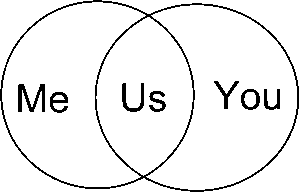
Difficulties In The Relationship Or Marriage We may be struggling in our relationship, marriage. An aspect of our relationship, marriage may trouble us, it may be fragile, unstable. Things may be unravelling, escalating in our relationship, marriage, and we may want to work out what's happening, or find our way through a difficult time. For all men and women, every relationship or marriage has difficult times, dilemmas, frustrations, conflict, pressures, ups and downs, and middle ground. How we navigate these may be challenging, which can be explored in the relationship counselling. We may struggle to "get" our partner, or they - "get" us. Some of us may never be satisfied, looking for problems in the relationship or even sabotage things. We may have other concerns. Our relationship may not be very loving. Sustaining and nurturing our relationship may be a problem for some. Inside we may feel very alone, lonely, our relationship may have become stale, stuck. Desire and expressions of love may have diminished. How much to give or take in the relationship or marriage maybe a question we have. The relationship may be in crisis, have challenges, call upon changes, transformation. We may feel emotionally drained or confused by a certain issue, which doesn't go away (see also Being Together Through Relationship Struggles). Being an individual and together as a couple, work/life balance, creating quality time presents its own emotional challenges, human struggles, "bad patches", temptations, egos that get in the way, challenges and resilience - so does living apart. Small things can rapidly escalate. Relationship problems or marriage problems can seem insurmountable. The relationship counselling can also explore the relationship dynamics between us and our partner. Some of us may be concerned that our relationship might, or has, broken down which may relate to negotiating through relationship challenges, phases. There may be a mismatch between us and our partner about each other's expectations of the relationship or marriage. Each may have a different pace. Often two people are at different places in their life journey, and we may tend to look to our partner to resolve our own issues or problems. And we may also want to consider that our relationship itself is a journey more than a destination, that some difficulties in relationship cannot be overcome, more lived with creatively. Relationship counselling and marriage therapy can support us in the difficulties we are facing, explore courageous ways how our relationship, marriage can be improved, difficulties weathered, challenges overcome, letting go of old patterns, building upon, creating its potential, so ruptures can be repaired. (See also Relationship Problems & Marriage Problems - Counselling London)
The course of true love never did run smooth.William Shakespeare

Strong Feelings In The Relationship Or Marriage Relationships can trigger so many things in us (see also Relationship Style, Attachment Patterns). Our relationship or marriage may have become fragile. In other areas of our life we can be competent, yet in our relationship our best and worst aspects can come out. Being in the relationship can bring out sides of us even we didn't know we had. The person we love can at times be the person we can't bear being with. We may be reasonably rational, yet our relationship may be emotionally difficult or stormy and we may be torn apart by something. Things may have become intense. One of us may be sensitive inside or walking on eggshells. Dialogue may have broken down. All our old hooks and triggers may be in play. Rejection, betrayal, hurt, pain, old wounds, may play a role. We may have powerful reactions if at times we feel unloved, abandoned, rejected, unseen and unsupported (see also Influence Of Our Past On Our Relationship Or Marriage). The differences between us and our partner have the potential to push us further apart or unite us as a couple, grow in our differences. Relationship counselling and marriage psychotherapy can support us in our struggles or problems, destructive cycles (rather than having to act any of them out in our relationship, marriage) and can help find out what else may be manifesting at a deeper level.

Lost Intimacy, Healthy Sex Life Much of our anxiety, fears about our relationship, marriage, may be about our need and struggle to be intimate with our partner. This may or may not include sexual intimacy. Empty inside, we may be longing, yearning for a deeper intimate connection with our partner. As a man or a woman it may be important for us not to give up hope for a fulfilling, healthy, meaningful and intimate relationship. In the relationship or marriage we may also have forsaken a lot of who we are. We may have become more like friends, siblings and thwarted our male or female energy, including our libido, desire. Sexual attraction or sexual problems may be a concern.
Additional Stresses & Strains In The Relationship Or Marriage A range of experiences can add stress and strain to our relationship or marriage. These may include the impact of:
- An affair
- Health concerns
- Unhelpful habits or addictions
- Work stresses, including redundancy & retirement
- Sexual abuse
- Dilemmas of whether to start a family, pregnancy, having children, parenting, pregnancy termination
- Children & family life
- Tiredness, exhaustion affecting our relationship or marriage
- Family crisis or problems
- Step-family relationships
- The effect of cultural, religious differences between us & our partner
- Our relationship fears

Disappointment In The Relationship Or Marriage What seemed the near perfect relationship, may have slowly evolved to become disappointing. Our hopes get dashed. "Is this it, now what?" we may ask. The person we once idealised, or our dreams for the relationship, may have fallen short. What started off as endearing (e.g. our partner's traits or habits) can end up irritating us. We may have believed that as long as two people love each other, everything will be fine, yet problems emerge. We may have viewed the relationship as if it is something outside of us, entirely separate, that we are somehow not also responsible. Routines, day to day tasks, work worries may dominate. We or our partner may have become neglectful, as if at times living parallel lives in a transactional relationship, let ourselves go in certain areas. We may have overlooked nurturing the relationship, communicating well. Getting to know each other again and differently in the relationship may be a consideration. our disappointment with our partner and the relationship or marriage mean for us can be explored in the relationship counselling or marriage therapy. This may involve getting to know and revisiting our own expectations and disappointments.
Stepping Back, Reflecting Upon Our Current Or Previous Relationships Or Marriage The relationship or marriage may be in crisis, which can be a real worry, yet it may also demonstrate that something important needs attention, pointing towards opportunities to build something new or different, transforming it. Although our relationship may be in trouble, we may be considering ending it, yet also wonder if the same issues and patterns will reoccur in a future relationship or marriage, e.g. wanting our partner to change. Exploration of the patterns or themes in our relationship, our values, how we personally relate and how we communicate as a couple may be a need for some. We may want to learn about the role we personally play in order to change the things we want to change. (It may be uncomfortable for us to look at how we may get in the way of the relationship, marriage thriving by the consequences of how we are, what we do, don't do.) Usually there are various reasons why relationships get into difficulties, and there is rarely only one answer to problems. If only we could solve our problem with an easy formula. Relationships are both complex and simple in our need to love and be loved. It can seem impossible at times to believe that the problem or turmoil in our relationship or marriage can be overcome, that the relationship can get back on track. Throughout the relationship or marriage a lot of water may have flown under the bridge and we may be questioning if the relationship can be recovered. Nurturing the relationship and continuing to learn about our partner can be missing. Developing different skills, and finding our own way to break through any impasse can be possible. Some may be reflecting on what may have been wasted, our lost youth, and this loss may lean heavy on us. The way we are now may also date back to earlier experiences - attracted to people who are similar to either one or both of our parents. Our past can creep into our adult life and for some couples it can seem as if we experience each other at a common level of wounding, hurt, pain (see also Hurt & Pain In Relationships). We may have abandoned ourself, being overly focused on giving our partner what they need, project our unwanted aspects onto our partner and our partner can be a useful mirror to us especially if we struggle to acknowledge that relationships are often imperfect. Relationship counselling and marriage therapy can help you reflect on how you see your relationship or marriage, what might be happening for you (consciously and unconsciously), looking at your life as a whole and what it means. Taking time to personally reflect upon the positive and negative aspects of our relationship, marriage may be important.
Our relationship is also a mirror for ourself.
Our most significant relationship (notwithstanding the one with our self) happens in the first years of our life and these implicit relational experiences become knowledge we carry, manifesting in our adult relationships (which mirror past relationships with our parents recreated by us), through behaviours, expectations and how we feel about each other (see also Relationship Style, Attachment Patterns).
Contemplating Ending The Relationship Or Marriage On The Rocks Our relationship may be at a tipping point, not be thriving. We may have mixed ambivalent feelings, doubts about the relationship (part of us may want to make the relationship or marriage work, yet another part of us is contemplating ending it). Some of us may be clinging on to the relationship or marriage. We may be questioning if we are right for each other. We may be worried that the relationship is over, or think of ending the relationship or marriage, yet at the same time question if we are running away from things. We may want to come to relationship counselling simply to build a healthier relationship, or to consider its ending (see also Cooling Off Periods, Trial Separation, Controlled Separation - Exploring Our Options). And some of us may know that it needs to end, yet fear being on our own, rejection, abandonment. Confused, it may be important for us to maintain a sense of self, and think clearly.
After The Relationship Or Marriage Has Ended - Counselling London
Ending The Relationship, Marriage Our relationship or marriage may have just ended (see also Towards Break Up, Separation, Divorce & Beyond). The ache of separation can be hard to bear and getting over the relationship or marriage takes time. It is understandable we may be raw, hurt, in pain, shocked, angry, confused, stuck, lonely or maybe relieved. Letting go, adjusting to our new circumstances can be a challenge. Relationship counselling and marriage therapy can support you in this difficult period of transition and transformation. You may also want to use the relationship counselling as a way of learning about you and your role in relationships, in order to move forward.
What To Expect From Relationship Counselling London
Couple's counselling & marriage therapy for individuals (not couples) is available for people who want to explore in depth some of the following:
- Where you stand now, your needs & how flexible you are
- Nature of your problems in the relationship
- The role you play in any relationship problems
- How problems have arisen & what gets in the way of change
- Your hopes, beliefs, attitudes & expectations for the relationship
- Identifying & managing your personal problems
- All aspects of you & your role in the couple
- Your own resources & your resources as a couple
- Your patterns in the dynamics of relationship
- Your role in making the relationship a success
- Your disappointments & moving on from them
- How sabotage happens
- Control issues
- How to be an individual, yet part of the couple
- Your opinions & how you behave
- How you can argue less about who is right or wrong
- How communication happens in the relationship, your communication skills & learning to listen
- How to translate any worries & perceptions for your partner
- Negotiating for good outcomes
- Ways to open up communication & work towards resolution
- How willing you are to engage
- Distinguishing between what you need & what you want
- The role of vulnerability or tenderness
- How powerful feelings like hurt, anger & fear play out
- How different men & women are (if applicable)
- How you can change yourself & the relationship
- Any effects of changes in you on your partner
- The future potential of your relationship
- Any unhealthy diversions, impulses, compulsions & addictions
- Any underlying problems & your early experiences
- Matrimonial problems, failing marriage, marriage problems
- Considerations of ending the relationship & looking at other options
If you have decided to end your marriage or relationship, counselling can help with:
- The consequences & impact of ending your relationship
- Making sense of changes & losses
- Recovering from the breakup, divorce
- Negotiating a period of readjustment, adaptation, reflection
- Exploring what else might be emerging or transforming for you
- Crossing new thresholds and moving forward

What NOT To Expect From Relationship Counselling
Relationship counselling and marriage therapy does NOT offer marriage advice or relationship advice on:
- Whether the relationship should end or not
- Damaging criticism of your opinions & actions
- If you should have a "trial separation"
- The "rights" and "wrongs" of your partner
- Changing your partner
- Marriage tips
Take into account that great love and great achievements involve great risk.Dalai Lama
FAQs about the Relationship Counselling London practice based in Kings Cross, Camden:
- What is the frequency of relationship counselling in London, Kings Cross?
- How many relationship counselling in London sessions do I need?
- How much does relationship counselling London cost?
- Must I visit your London counselling practice in Camden or do you offer Skype relationship counselling, online counselling or Telephone counselling?
- What are the advantages and disadvantages of offering online relationship counselling, Skype counselling or in-person counselling in London, Camden, Kings Cross
- Do you only offer relationship counselling in London, Camden or Kings Cross?
- What times do you offer relationship counselling in London, Kings Cross or Camden?
- How do I contact a relationship counsellor in London, Camden, or near Kings Cross?
- How effective is relationship counselling in London, Kings Cross, Camden?
- What can I expect from the initial session of relationship counselling London?
- What to expect from the other relationship counselling London sessions?
- What is the typical duration of the London relationship counselling services in Camden, Kings Cross
- I have relationship problems: how can relationship counselling in London help me?
- Will my relationship prblems go away by having relationship counselling in London

